

Every season spent working the land, planting in spring, baling hay in summer, and harvesting in fall, adds hours to a lifetime of unfiltered sun exposure that most farmers and ranchers never think twice about. That quiet, cumulative exposure is one of the most significant and least-discussed threats to long-term vision health, and it doesn’t announce itself until real damage has already been done.
At Vision Source Mandan, we serve a region deeply rooted in agriculture, and we see firsthand how outdoor occupations affect our patients’ eye health over time. Dr. Brittany Schauer, Dr. Wayne Aberle, and Dr. Danielle Dyke work with farmers and ranchers across Mandan, Bismarck, and the surrounding communities to catch UV-related eye changes early and keep vision sharp for every season ahead.
How UV Radiation Damages the Eyes Over Time
Ultraviolet radiation doesn’t cause immediate pain the way a sunburn on your skin does, which makes it easy to underestimate. But the eyes absorb UV rays continuously during outdoor exposure, and that damage compounds quietly over years and decades.
UV Exposure and Cataract Formation
The lens of the eye is particularly vulnerable to UV radiation. Research from the National Eye Institute confirms that chronic sun exposure increases the risk of cataracts through a process called oxidative stress, in which UV rays trigger harmful chemical reactions that gradually cloud the lens. A cataract evaluation becomes essential for anyone with significant lifetime sun exposure, and catching lens changes early creates more options for managing them.
Other UV-Related Eye Conditions
Cataracts are the most well-known consequence of UV exposure, but they are not the only one. Farmers and ranchers working in open fields, especially in reflective environments like snow-covered or sandy ground, face elevated risk for photokeratitis (essentially a sunburn on the cornea), pterygium (tissue growth on the eye’s surface), and accelerated macular degeneration. These eye diseases develop gradually and often go unnoticed until vision is meaningfully affected.
Why Farmers and Ranchers Face Higher Risk
Most people spend the majority of their day indoors, moving between buildings and vehicles. Farmers and ranchers don’t have that buffer. Long days in open fields, often at peak UV hours between 10 a.m. and 4 p.m., mean significantly more cumulative UV exposure than the average person accumulates across a lifetime. North Dakota’s wide-open skies and reflective snowpack during calving and early planting season amplify that exposure further.
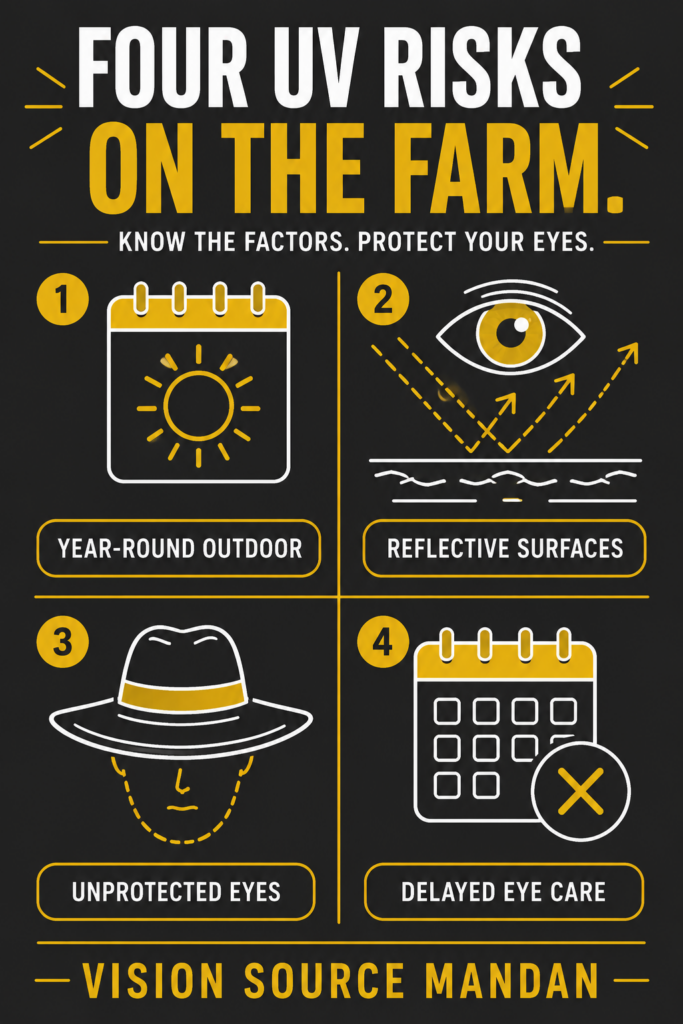
The following factors compound UV risk for agricultural workers specifically:
- Year-round outdoor hours: Unlike seasonal outdoor recreation, farming and ranching involve daily, multi-hour sun exposure across every season.
- Reflective surfaces: Snow, water, and dry soil reflect UV rays upward toward the eyes, increasing exposure even on overcast days.
- Limited protective eyewear use: Many outdoor workers wear brimmed hats but skip UV-blocking eyewear, leaving the eyes largely unprotected.
- Delayed eye care: Busy seasons and long distances from care can push routine eye appointments down the priority list for years at a time.
Awareness of these compounding factors is the first step toward changing habits that protect vision for the long term.
What Protection Actually Looks Like
Sunglasses are the most accessible tool for UV protection, but not all lenses are equal. Wraparound frames with lenses rated for 100% UV-A and UV-B blockage offer meaningful protection for outdoor workers. Polarized lenses can reduce glare from reflective surfaces, which is especially valuable on snow or water. Our team can help fit protective lenses and frames suited for full days outdoors rather than occasional wear.
Beyond eyewear, regular eye exams are non-negotiable. UV damage to the lens develops without symptoms, which means the only way to catch it early is through a dilated exam that allows a clear look at the health of the lens and retina. For patients with decades of outdoor work behind them, we recommend discussing cataract risk directly during each visit. Our Cataract Awareness Month blog offers additional context on what to watch for as the lens ages.
Eye Care at Vision Source Mandan for Outdoor Workers
Vision Source Mandan has been caring for the eyes of Mandan, Bismarck, and surrounding North Dakota communities since 1950, and many of our patients are the same families who have farmed and ranched this land for generations. Dr. Schauer, Dr. Aberle, and Dr. Dyke understand the demands of agricultural life and approach every exam with the full picture of a patient’s lifestyle and occupational history in mind.
If you work outdoors and it has been more than a year since your last comprehensive exam, don’t put it off another season. Reach out through our contact form to schedule an appointment and protect the vision you depend on every day.