
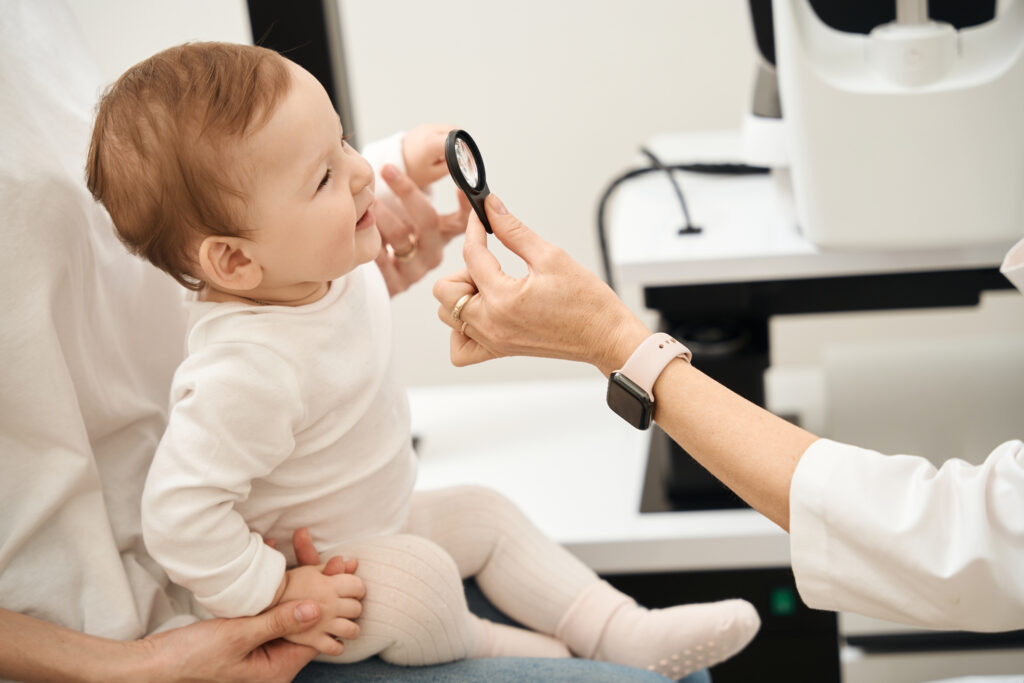
Your baby’s vision develops rapidly during the first year of life, laying the foundation for how they’ll see and learn throughout childhood. The InfantSEE program provides comprehensive eye assessments for infants between six and 12 months old at no cost to families, regardless of income or insurance status. This public health initiative ensures every baby has access to early detection of potential vision problems that could impact their development.
At Vision Source Mandan, we proudly participate in the InfantSEE program through the American Optometric Association. Our team provides these assessments as a public service to help families in Mandan, Bismarck, and surrounding communities give their babies the best start possible. Early detection makes all the difference in protecting your child’s vision and overall development.
What Is the InfantSEE Program?
InfantSEE is a national public health program managed by Optometry Cares, the AOA Foundation. The program addresses a critical gap in infant wellness care by making comprehensive eye assessments accessible to all families. We recommend scheduling your baby’s first eye exam between six and 12 months of age, when visual development is most dramatic and early intervention can prevent serious problems. At Vision Source Mandan, we prefer to see infants at 6 to 7 months old to make the exam easier for the child and us.
Who Qualifies for InfantSEE
This program exists because eye and vision care should be an essential part of infant wellness routines, just like pediatrician visits. The goal is to ensure that family income and access to insurance coverage never become obstacles to receiving proper eye care.
Every infant between six and 12 months of age qualifies for this no-cost assessment, regardless of their family’s financial situation or whether they have vision insurance. Participating optometrists across the country provide these assessments as a public service, demonstrating our commitment to the health and well-being of the youngest members of our communities.
What We Examine During the Assessment
During an InfantSEE assessment, we test for excessive or unequal amounts of nearsightedness, farsightedness, or astigmatism to check your baby’s prescription. We also evaluate eye movement ability, how well the eyes work together, and examine the overall health of the inside and outside of the eye. We discuss your family history and any concerns you might have about your baby’s vision development. This comprehensive approach helps us identify any risk factors that could affect your child’s visual development.
What Happens During an InfantSEE Assessment
You might wonder how we can examine a baby who can’t read an eye chart or follow verbal instructions. We use specialized tools and techniques designed specifically for infants. By shining lights into your baby’s eyes and observing their responses, we can determine their prescription for glasses, assess eye health, and evaluate visual acuity without your baby needing to say a word.
We also use paddles with different grating lines to assess visual acuity based on where your infant looks. This gives us valuable information about how well they can see, even though they’re too young to communicate verbally. The entire process is gentle and non-invasive.
Why Early Eye Exams Matter for Your Baby
Visual development occurs most rapidly between six and 12 months of age. This critical period establishes the foundation for how your child will see and process visual information for the rest of their life.
The Risks of Undetected Vision Problems
According to the American Optometric Association, one in every four children in the U.S. has a vision disorder that requires diagnosis and treatment from an eye doctor. If problems go undetected during these younger years, they can lead to permanent vision impairment or become significant barriers to learning later on. Undetected and untreated conditions such as amblyopia (lazy eye) and strabismus (crossed eyes) can become barriers to learning, leading to delayed reading and poorer school performance.
Conditions We Can Detect Early
While serious problems are uncommon, early detection of rare conditions can be life or vision-saving. The InfantSEE assessment allows us to identify the following potential issues during this crucial developmental period:
- Retinoblastoma: A rare form of eye cancer that can affect infants, which requires immediate detection and treatment
- Amblyopia (lazy eye): A condition where one eye doesn’t develop normal vision, which is most treatable when caught early
- Strabismus (crossed eyes): Misaligned eyes that can affect depth perception and visual development
- Significant refractive errors: High levels of nearsightedness, farsightedness, or astigmatism that can impact visual development
- Eye health problems: Structural abnormalities or diseases that may affect your baby’s vision
When we catch potential issues early, treatment is far more effective. Vision development and eye health problems are much easier to correct when intervention begins during infancy.
Schedule Your Baby’s No-Cost InfantSEE Eye Assessment at Vision Source Mandan
Vision Source Mandan has been serving families in Mandan, Bismarck, and surrounding communities for over 70 years. Under the leadership of Dr. Brittany Schauer, who serves on the North Dakota Optometric Association board, along with Dr. Wayne Aberle and Dr. Danielle Dyke, we combine advanced diagnostic tools with compassionate care. We’re committed to building trusted, long-term relationships with our patients, starting from their very first eye exam as infants.
Don’t wait to give your baby the gift of healthy vision. Contact us today to schedule your infant’s no-cost InfantSEE assessment and ensure their eyes are developing properly.